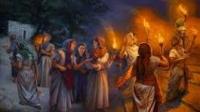
The role of the bridesmaid in the time of Jesus was an important one. They were young women, friends or relatives of the bride, who would assist with the preparations, help the bride to dress and lead a torchlight procession to to meet the bridegroom and his attendants on his way to his home or that of his parents. Often the marriage negotiations at the bride’s home would take time, so the bridegroom could be late, as in this parable.
All the bridesmaids carried torches, which were rags soaked in olive oil, fixed to a pole. However, the foolish ones had not brought spare oil. Olive oil symbolises the Holy Spirit, providing warmth, light and healing. It is used for anointing in some sacraments. The bridegroom is Jesus Christ, and the bridesmaids are his followers. In the parable of the sower (Matt. 13:1-9) some seed did not develop to maturity for various reasons. People are attracted to Christ but do not complete the journey with him. It would seem that it was the same with the bridesmaids. They had not prepared themselves for full discipleship, or thought their role through properly. They were not in for the long haul.
At the same time the closed door and the bridegroom’s rejection of them seems at odds with the Christ who forgave the thief, even at the eleventh hour (Luke 23:39-43). Of all the evangelists, Matthew is the one who stresses judgement most. Perhaps he omits the appearance of the bride, who does not take part in the story, as his way of pointing to the end of time, when the bride, the Church, will finally be united with the bridegroom.