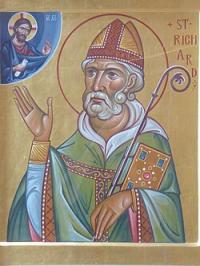
Feast day: 3 April
St Richard of Chichester was born in the Burford area, near the town of Wyche (modern Droitwich, Worcestershire). He came from a family of gentry but was orphaned. His elder brother inherited the estate but was subjected to a feudal wardship till he came of age. He was then required to pay a death duty that impoverished the family. Richard therefore had to work for him on the farm. His brother made him his heir but soon Richard gave up his claim and refused to marry a noble lady; he chose instead a life of study and religious life. He was educated at Oxford University and began to teach there. He went to Paris and Bologna, where he distinguished himself in canon law. When he returned in 1235, he was elected as Chancellor of Oxford.
His former tutor, Edmund Rich of Abingdon, had become Archbishop of Canterbury. Richard shared some of his ideas on clerical reform and supported papal rights, even against the king. Archbishop Edmund appointed Richard chancellor of the diocese of Canterbury. Richard joined the Archbishop during his self-imposed exile in Pontigny. He was with him when he died in c.1240. Richard then decided to become a priest and studied for two years with the Dominicans at Orleans. Upon returning to England he became parish priest at Charing and then at Deal, but was soon reappointed Chancellor of Canterbury by the new Archbishop, Boniface of Savoy.
In 1244 Richard was elected Bishop of Chichester. King Henry III and part of the chapter refused to accept him, choosing another candidate instead. Archbishop Boniface refused to confirm their choice and both sides appealed to the Pope. He confirmed Richard’s election and consecrated him in Lyons in 1245. Henry confiscated the see’s properties and only returned them when threatened with excommunication. He forbade anyone to house or feed Richard. He meanwhile lived with his friend Simon, visited his diocese on foot and cultivated figs in his spare time.
He was frugal, wore a hairshirt and refused to eat off silver. He was also vegetarian. He provided the chronicler Matthew Paris with material of the life of St Edmund Rich and instituted the offerings for the cathedral at Chichester which were known later as “St Richard’s pence.” He was a disciplinarian, and was merciless to usurers, corrupt clergy and priests who mumbled at mass. He showed favour to the Dominicans who had sheltered him when he lived in Orleans. After dedicating St Edmund’s chapel at Dover, he died in 1253. He was buried in the chapel on the north side of the nave of the cathedral in Chichester, dedicated to his patron St Edmund. His remains were translated to a new shrine in 1276.
Richard was a reforming bishop. He stood up to King Henry on many occasions to protect the rights of the church. He produced a body of statutes, with the aid of his chapter, for the organisation of the church in his diocese.He stopped the practice of clergy marrying secretly, though the status of the wives in these unions was considered to be that of a mistress. Such clergy would be deprived of their benefices and their partners could not inherit their property. A vow of chastity was required for all candidates for ordination. Priests were expected to live in their parishes and have only one freehold to live on. They were bound to pay tithes. Anyone who failed to pay would not be granted forgiveness until they did. There were regulations about the sacraments, about vestments, chalices and content of the communion hosts. Archdeacons were to administer justice fairly and to visit churches frequently to ensure everything was as it should be. Clergy should wear proper dress and not imitate what lay people wore. The names of excommunicated persons was to be read out four times a year in parish churches. A copy of these statutes was to be kept by every priest in the diocese and to be brought by him to the episcopal synod.
Richard’s shrine in Chichester was for a long time a place of pilgrimage. Just nine years after his death he was canonized by Pope Urban IV in 1262. The shrine was destroyed during the Reformation. The relics may have been removed but this is uncertain. A relic was returned from Normandy in 1991 and is now interred behind the altar in Chichester Cathedral. The modern shrine of St Richard is located in the retro-quire of the cathedral. Another relic, returned from Rome, is housed in the Bishop’s chapel.
This is a prayer of St Richard which became very popular.
Thanks be to Thee, my Lord Jesus
for all the benefits Thou hast given me,
for all the pains and insults Thou hast borne for me.
O most merciful Redeemer,friend and brother,
may I know Thee more clearly
love Thee more dearly
follow you more nearly,
day by day.
St Richard of Chichester, pray for us.