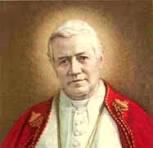
Feast day: 21 August
Pius X was born Guiseppe Melchiorre Sarto in 1835, in Riese, in the Kingdom of Lombardy-Venetia, then part of the Austro-Hungarian Empire. He was the second of ten children of Giovanni Baptista Sarto and his wife Margherita. Giovanni was the village postman and by trade a cobbler. Though poor, his parents valued education and he walked six kilometres to school every day. He was an excellent student, putting homework before hobbies and recreations. Before he returned home after sports or games with his friends, he would spend ten minutes in prayer.
By the age of ten he had completed the two elementary classes of his village school and henceforth had to walk over six kilometres to the gymnasium in Castelfranco Veneto, for further classes. For the next four years he would attend mass before breakfast and his long walk to school.
In 1850 Guiseppe received the tonsure from his parish priest. This was the first step on his path to ordination. The priest wrote to the Cardinal of Venice to secure Guiseppe a scholarship to the seminary of Padua, where he completed his classical, philosophical, and theological studies with distinction.
In 1858 he was ordained a priest by the Bishop of Treviso and he became chaplain at Tombolo. He continued to study theology, which included the works of Thomas Aquinas, and canon law. He also carried out the functions of the sickly parish priest. In 1867 he was made archpriest of Salzano. He restored the local church and expanded the hospital, funding it through his own resources, which included begging. He became popular with the people when he worked to assist the sick during the cholera outbreak in the early 1870s.
He was appointed a canon of the cathedral and chancellor of the diocese of Treviso, also acting as spiritual director of the Treviso seminary and examiner of the clergy. He was eager to bring religious instruction to public school students and also to the poor and urban youth, who could not attend school.
After 1880, Guiseppe taught dogmatic theology and moral theology at the seminary at Treviso. In November 1884 he was appointed Bishop of Mantua by Pope Leo XIII. Since he lacked a docterate, he required a dispensation. He was appointed to the honorary position of assistant at the pontifical throne in June 1891. When he returned to his home town, his mother kissed his ring repeatedly. However she said: “But you would not have this fine ring, son, if I did not have this.” She proceeded to show him her wedding ring.
Pope Leo made Guiseppe a cardinal in 1893 and appointed him patriarch of Venice. This caused difficulty, as the newly-formed Italian state insisted on the right to nominate the patriarch as the Emperor of Austria had done. There were bad relations between the Holy See and the Italian state over the seizure of the papal states. However Guiseppe finally assumed the position of patriarch in 1894. He told the local newspaper that he felt “anxious, terrified and humiliated” on becoming a cardinal. Before leaving for Venice, his mother asked for his blessing, sensing it would be the last time they would see one another.
As patriarch Guiseppe avoided politics, devoting himself to social work and strengthening parochial credit unions. However in a letter to the Venetians, he insisted on unquestioning obedience to the pope. Leo XIII predicted that Guiseppe would succeed him. He himself declared: “Rather dead than pope”. Pope Leo died in 1903.
At the conclave, there was interference from the Austrian Emperor Franz Joseph through a Polish Cardinal, who vetoed the choice of the favourite, who was the late pope’s Secretary of State. This was the last time a papal veto was exercised by a monarch. On the fifth ballot Guiseppe Sarto was elected pope. He took the name of Pius X, honouring particularly Pius IX, who fought against theological liberals and for papal supremacy. “As I shall suffer, I shall take the name of those Popes who also suffered,” he declared. His mission statement was: “We champion the authority of God. His authority and Commandments should be recognized, deferred to and respected.”
Pius was noted for his simple lifestyle. He wore a pectoral cross made of gilded metal on his coronation, to the horror of his entourage. He reduced papal ceremonies and dined with friends, rather than alone like previous pontiffs. He refused to enoble his family. He loved children; when he was bishop in Mantua and Venice he would carry sweets in his pocket for the poor ones, and now in papal audiences he would gather children around him and talk to them about things that interested them. He taught weekly catechism in the courtyard of San Damaso in the Vatican, always keeping a special place for the young. He ruled that every parish should have a Confraternity of Christian Doctrine, so that children would have a knowledge of their religion. His care for them extended to lowering the age at which they could receive First Communion, from twelve to seven. In one case, where a four-year-old boy showed an exceptional understanding of the Eucharist, Pope Pius personally gave him communion.
The pontificate of Pius X contrasted sharply with that of his predecessor Leo XIII. The two Popes shared in common the promotion of the theology of Thomas Aquinas (the marriage of reason and revelation). However, whereas Leo had developed a Catholic Social doctrine, particularly in his encyclical Rerum Novarum which encouraged scientific thought and easing of relations with secular states, Pius went in the opposite direction. He vigorously opposed the theological movement he termed “Modernism” which applied critical thinking to church history and scripture. In his decree entitled Lamentabili Sane Exitu (A Lamentable Departure Indeed) Pius condemned 65 propositions - mainly drawn from the work of Alfred Loisy - concerning the nature of the church, revelation, biblical exegesis, the sacraments and the divinity of Christ. In a following encyclical, Pius described modernism as the “synthesis of all heresies.” All clerics were required to take an anti-modernist oath; most complied. Pius went further in establishing a network of informants, who would discover the non-compliant. One of those investigated was Angelo Roncalli, later Pope John XXIII, although he was later exonerated.
Pope Pius established a catechism for use round the world. He issued new rules enforcing the bishops’ oversight of seminaries and established regional seminaries. He instituted a new plan of seminary study and barred clergy from administering social organisations.
Pius’ policy towards the secular states was uncompromising. The Papal States had been lost between 1860 and 1870, and Pope Pius IX described himself as the “prisoner in the Vatican”. Pius X had the same approach and refused to leave the Vatican grounds. When the French president visited the King of Italy, Pius refused to meet him and reproached the president for his action. This led to a rift with France and the 1905 law of separation of Church and State. The church lost funding in France and the Jesuits were briefly expelled. The Pope was equally intolerant of secular governments in Portugal, Ireland, Poland, Ethiopia and other countries with large Catholic populations. This led to tension in Ireland, where the Protestant population feared Rome rule.
In 1908, the papal decree Ne Temere declared that marriages not performed by a Catholic priest were valid but sacramentally invalid. This again caused a great deal of heartbreak in Ireland and contributed to later political conflict. Priests were given the discretion to refuse mixed marriages and to insist that the children of such unions should be brought up as Catholics.
Pius suspended the work of the Opera dei Congressi, which coordinated the work of Catholic association in Italy, as well as condemning Le Sillon, a French social movement that tried to reconcile the Church with liberal political views. He also opposed trade unions that were not exclusively Catholic. He did relax the prohibition on Italian Catholics voting but never recognized the Italian State.
In 1904 Pope Pius received Theodor Herzl, father of modern political Zionism. He treated him with respect but refused to support his cause, citing the refusal of the Jewish people to recognise Jesus as the Messiah. He was unable to change the stance of the Orthodox Church in Russia towards Catholics. He was equally unsuccessful in his approaches to China. Pope Pius changed the missionary status of the United States, recognising the growth of the Church there. He created fifteen new dioceses during his pontificate and two American Cardinals were named. He was very popular in that country.
Pius X had a great devotion to Our Lady. In his encyclical Ad Diem Illum he described Mary as “restoring everything in Christ." During his pontificate, many famous Marian images were given a canonical acknowledgement, for example Our Lady of the Pillar and Our Lady of the Cape. Many miracles were ascribed to him in his lifetime, as well as after his death.
In 1913, Pope Pius suffered a heart attack and had poor health afterwards. He fell ill on the Feast of the Assumption in 1914 and it was reported that he suffered from fever and lung complications. The outbreak of World War I had a bad effect on his condition, as the pontiff fell into a mood of melancholy. He said, “In ancient times, the Pope by a word might have stayed the slaughter but now he is impotent.”
He received the Last Rites and eventually a bronchial infection that he had previously suffered from returned and pneumonia set in. He died on 20 August 1914. He was buried in a simple unadorned tomb in the crypt below St Peter’s Basilica. His body was exhumed in 1944 and found to be incorrupt. It was removed from its tomb, where it was placed under the Chapel of the Presentation, in a bronze and glass sarcophagus where it can be seen by the public. He was canonised by Pope Pius XII in 1954.
St Pius X, pray for us.