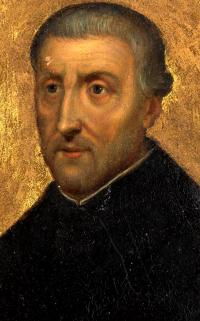
Feast day: 21 December
Peter Canisius was born in 1521 in Nijmegen, in the Duchy of Guelders which was then part of the Habsburg Empire and is now a province of the Netherlands. His father was a wealthy burgermeister (mayor), Jacob Kanis. His mother Aegidia van Houweningen, died shortly after Peter’s birth. At the age of fifteen he was sent to study at the University of Cologne, where he earned a Master’s Degree in Theology at the age of nineteen. There he met Peter Faber, one of the founders of the Society of Jesus. Through him Peter became the first Dutchman to enter the newly-founded order in 1543 and undertook the Spiritual Exercises of St Ignatius under the direction of Peter Faber. He was ordained in 1546 having finished his studies in theology. Through his preaching and writing he became one of the most influential Catholics of the time. He supervised the foundation and maintenance of the first German-speaking Jesuit colleges, often with few resources. At the same time he preached in the city and vicinity and debated and taught in the university.
Peter was a strong influence on the Holy Roman Emperor Ferdinand I. His son Maximilian, later Maximilian II, appointed a married priest to the office of court preacher. Peter strongly opposed this and Maximilian was obliged to dismiss the priest. He bore a grudge against the Jesuit ever after.
In 1547 Peter attended several sessions of the Council of Trent. He was an influential teacher and preacher, and produced a German catechism which defined the basic principles of Catholic doctrine, making them readily available to people in the German-speaking lands. He was offered the position of Bishop of Vienna in 1554. He declined because he wanted to continue his travelling and teaching. He did, however, administer the Diocese of Vienna for a year until a new bishop was appointed.
He moved to Germany and was one of the main Catholic theologians at the Colloquy of Worms in 1557. He then went on to be the main preacher in the Cathedral of Ausburg from 1559 to 1568 where he gave witness to his faith three or four times a week. He was a popular preacher. In 1562 he founded what was to become the University of Innsbruck. Protestantism was regarded at this time as the religion of the erudite, while Catholicism was seen as that of the ignorant. Peter showed that it was eminently rational. Through his efforts he brought Bavaria and the Rhineland back to the Catholic faith. He also won converts in Austria, Hungary, Bohemia and Poland. Poland had become mainly Protestant but it was restored to Catholicism.
By the time Peter left Germany, the Society of Jesus had evolved from a small group of priests to a powerful tool of the Counter-Reformation. Peter spent the last twenty years of his life in Fribourg, Switzerland, where he founded the Jesuit College Sant Michel, which trained generations of young men for careers and studies at university. During this period his work Summa Doctrinae Christianae (1554) was translated into almost every European language, including Scots.
In 1591, at the age of 70, Peter suffered a stroke which left him partially paralysed, but he continued to preach until his death in 1597. He was initially buried in the church of St Nicholas. His remains were later transferrred to the church of the Jesuit College which he had founded. He was interred in front of the main altar of the church; the room he occupied during his last years is now open for veneration. He was canonised by Pope Pius XI in 1925 and declared a Doctor of the Church.
Peter rejected attacks against Calvin and Melanchthon, saying, “With words like these, we don’t cure patients, we make them incurable.”
Peter maintained that while there are many ways to God, the best is the veneration of Mary. He added the phrase, “Holy Mary, Mother of God, pray for us sinners"", which had not commonly been recited. It was added to the catechism of the Council of Trent. He promoted sodalities of Our Lady. He wrote a book of the Catholic teaching on Mariology, ordered by Pope Pius V, quoting authoritative sources.
St Peter Canisius, pray for us.