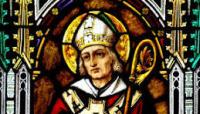
Feast day: 10 October
Paulinus was a monk from Rome, sent along with others by Gregory the Great in 601 as part of the second group of missionaries to convert the Anglo-Saxons to Christianity. He was probably an Italian by birth. This second group arrived in Kent in 604 but little is known of Paulinus’ activities there. He stayed in Kent till 625, when he was ordained bishop by Justus, Archbishop of Canterbury. He then accompanied Ethelburg, the sister of King Eadbald of Kent, to Northumbria, where she was to marry King Edwin. A condition of the marriage was that the princess was to be allowed to remain a Christian and to worship freely. The historian Bede, writing in the eighth century, reports that Paulinus wanted to convert the Northumbrians as well as provide religious services to the new queen.
Bede described Paulinus as a man “tall of stature, a little stooping, with black hair and a thin face, a hooked and thin nose, his aspect both venerable and awe inspiring.” Bede relates that Paulinus told Edwin that the birth of his daughter at Easter 626 was because of Paulinus’ prayers. The birth coincided with a foiled assassination attempt on the King by a group of West Saxons from Wessex. Edwin promised to convert to Christianity and allow his new daughter Eanflaed to be baptised, if he won a victory over Wessex. In spite of his victory, however, he did not fulfil his promise immediately. He only converted when Paulinus had revealed the details of a dream Edwin had before he became king, during his exile in East Anglia. In the dream, according to Bede, a stranger told Edwin that power would be his in future, when someone laid a hand on his head. As Paulinus was revealing the dream he laid his hand on the king’s head, which was the proof Edwin needed. A late seventh-century hagiography of Pope Gregory claims that Paulinus was the stranger in the dream. If that was true it might suggest that Paulinus spent some time in East Anglia, though Bede makes no mention of this.
The Northumbrian nobles were willing to become Christians and the King had received letters from Pope Boniface V, urging his conversion. He and his courtiers were baptised in York in 627. One story relates that during a stay with the King and Queen at their palace at Yeavering, Paulinus spent 36 days baptising new converts. He was also active in Lindsey. Pope Gregory had planned that York would be England’s second metropolitan see, so Paulinus established his church there. Although it was built of stone, no trace of it has been found. He also built churches on royal estates. His church in Lincoln has been identified with the earliest phase of the building of St Paul in the Bail. Among those baptised were Hilda, later the founding abbess of Whitby Abbey and Hilda’s successor, Eanflaed, Edwin’s daughter. As the only Roman bishop in England, Paulinus also consecrated another Gregorian missionary, Honorius, as archbishop of Canterbury after Justus’ death, sometime between 628 and 631.
Edwin was defeated by an alliance of Gwynedd Welsh and Mercian Angles, and was killed on the battlefield of Hatfield Chase. This battle was probably in 634. Edwin’s defeat led to his kingdom fragmenting into at least two parts. There was a sharp decline in Northumbrian Christianity. Edwin’s immediate successors reverted to paganism. The widowed queen fled to her brother’s kingdom in Kent. Paulinus went with her, along with her children and grandchildren. Paulinus was offered the see of Rochester which he held until his death. His deputy, James the Deacon, remained in the north and struggled to rebuild the Roman mission.
Paulinus died on 10 October 644 at Rochester. He was buried in the sacristy of the church. After his death he was revered as a saint. When a new church was built at Rochester in the 1080s, his relics were moved to a new shrine.
Bede indicates that the conversion of Northumbria was a success but it seemed to have reverted to paganism. It was left to Oswald, Edwin’s later successor, to reunite the kingdom and, having been converted to Christianity himself, he brought Irish missionaries to complete the work which Paulinus had begun.
St Paulinus, pray for us.