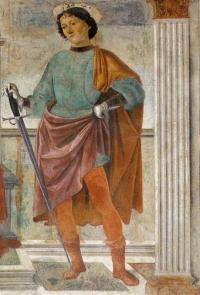
Feast day: 12 February
The earliest reference to Julian dates to the late twelfth century. There are three different locations for his origins, Le Mans, Ath in Belgium, and Naples. According to Jacobus de Voragine, author of the 13th-century Golden Legend, on the night Julian was born, his father, a noble, saw pagan witches secretly lay a curse on the boy that would make him kill both his parents. He wanted to get rid of the child but his mother stopped him. As he grew into a handsome young man, his mother often wept because of the sin he would commit. He however reassured her that he would never commit such a sin and “with great belief in Christ went off full of courage.” After fifty days of walking, he finally reached Galicia, where he married a “good woman”, said to be a wealthy widow.
Twenty years later his parents went to look for their son. When they arrived, they visited the altar of St James, son of Zebedee. On leaving the church they met a woman sitting on a chair outside, whom they asked for shelter for the night as they were tired. She took them in and told them that her husband Julian was out hunting (he is known as the patron saint of hunters). Having found their son, the parents were overjoyed, as was Julian’s wife. She treated them well and gave them Julian’s bed. However, Satan told Julian that his wife was with another man. Julian returned home and finding a man and woman in his bed killed them, thinking they were his wife and a lover. Overcome with remorse when he discovered his mistake, Julian vowed to spend the rest of his life doing charitable works. He and his wife made a pilgrimage to Rome. They continued their travels till they came to a river crossing. There they built a hospice to welcome weary and sick travellers and Julian assisted people in crossing the river.
In another legend, the devil, disguised as pilgrim weak from travel, was admitted to the hospice. That night he wreaked havoc in the house, causing mess and destruction. Julian on seeing the damage vowed never to let anyone into his house again. Jesus came to his house seeking shelter but was refused entry. Then Julian recognized him and decided to help all those who needed it again.
St Julian, called the Hospitaller, was a very popular saint in the Middle Ages, when travel was difficult and probably dangerous. People prayed to him for safe shelter. In Boccacio’s Decamaron, one story is entitled “The Miracle of St Julian.” In Chaucer’s Canterbury Tales, the Franklin is described thus: “Seint Julian he was in his contree.” He kept his table constantly ready for guests, as a sign of his hospitality.
In Malta, devotion to St Julian began in the fifteenth century after the discovery of his relics in the city of Macerat in Italy. Three churches were built in his honour. The Knights Hospitaller, a miltary order, arrived in Malta in the sixteenth century and spread the devotion to St Julian. They rebuilt the church in Senglea and in 1590 built another church in the parish of Birkirara, a section that since then has been called St Julian’s. In 1891 the church was made a parish and dedicated to St Julian.
St Julian the Hospitaller, pray for us.