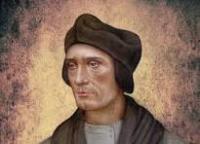
Feast day: 22 June
St John Fisher was born in 1469 in Beverley, Yorkshire. He was the son of Robert Fisher, a prosperous mercer of Beverley, and his wife Agnes. They had four children. Robert died in 1477 and his widow remarried a man named White, with whom she had four more children. John’s early education was probably at the collegiate school in his home town. Since he had an aptitude for learning, he was admitted to the University of Cambridge in 1482 at the age of thirteen or fourteen. This university had regressed and stagnated academically. In an address to Henry VII in 1506, John Fisher praised the king for his encouragement of learning.
At Cambridge, John came under the influence of William Melton, a pastorally-minded theologian open to the reforms created by the Renaissance. John received the Bachelor of Arts degree in 1487. He proceeded to a Master of Arts degree and was elected fellow of his college. In 1491 he received a papal dispensation to enter the priesthood, despite being under canonical age. He was ordained to the priesthood and appointed nominal vicar of Northallerton, Yorkshire.
In 1494 he resigned this benefice to become proctor of the university; three years later was appointed master debater and at the same time he became chaplain and confessor to Margaret Beaufort, mother of Henry VII. On 5 July 1501 he received the degree of Doctor of Theology and ten days later was elected Vice Chancellor of the university. Lady Margaret, guided by John, founded St John’s and Christ’s colleges at Cambridge and a Lady Margaret professorship of Divinity at each of the two universities of Oxford and Cambridge. John became first occupant of the Cambridge chair. Between 1505 and 1508 he was also the president of Queen’s College. At the end of 1516 he was at Cambridge for the opening of St John’s College and he consecrated the chapel.
He assembled funds and attracted leading scholars to Cambridge from Europe, to promote the learning of Latin, Greek and Hebrew. He encouraged preaching and pastoral commitment. He managed to administer the entire university. He was particularly anxious to encourage prayer for the dead, especially through chantry foundations. He was stern and austere and was known to put a human skull on the altar during Mass and on the table during meals. Erasmus said of John Fisher: “He is the one man at this time who is incomparable for uprightness of life, for learning and for greatness of soul.”
In 1504 John Fisher was appointed Bishop of Rochester, at the personal insistence of Henry VII. It was the poorest diocese in the country and was regarded as a stepping stone to greater things. John, however, remained as its bishop for the remaining 31 years of his life. He retained commitments to the university and was elected its chancellor in 1504, eventually receiving a lifetime’s appointment. He is also said to have been tutor to the young Henry VIII. He was an eloquent preacher and gave the funeral oration for both Henry VII and his mother Margaret, both of whom died in 1509.
He invited Erasmus to visit Cambridge. In 1512 he was nominated as an English representative to the Lateran Council but the journey to Rome was postponed and finally abandoned.
John Fisher was the first to pinpoint justification by faith alone as the basic doctrine of the Protestant Reformation. He may have been the true author of Defence of the Seven Sacraments, published in 1521, which won the title “Defender of the Faith” for Henry VIII. He published a 200,000 word response to Luther’s Assertio Omnium Articulor. In 1526, at the King’s command, he preached a famous sermon against Luther at St Paul’s Cross. He offered to dispute with Lutherans.
He became Queen Catherine of Aragon’s chief supporter when Henry tried to annul their marriage. He appeared on the Queen’s behalf in the legate’s court and declared himself willing to die for the indissolubility of marriage, as John the Baptist had done. Henry VIII was so enraged by this that he composed a long Latin address to the legates in answer to the bishop’s speech. John’s copy of this still exists, with annotations in the margin, which showed how little he feared the royal anger. When the cause was removed to Rome, his personal involvement came to an end but the King never forgave him.
In 1529 the “Long Parliament” of Henry’s reign began to encroach upon the Catholic Church’s prerogatives. As a member of the House of Lords, John warned parliament that such acts could only lead to the destruction of the Church in England. The Commons, through their speaker, complained to the King that John Fisher had disparaged parliament. The King was probably behind the complaint. Henry summoned the bishop and demanded an explanation. At this time he declared himself satisfied, leaving the Commons to make a decision. He thus appeared as a magnanimous sovereign, instead of John’s enemy.
A year later, because of the continuing attacks on the church, John Fisher and the bishops of Ely and Bath appealed to the Holy See. Henry immediately issued an edict forbidding such appeals and the three bishops were arrested. However they were only imprisoned for a few months as in 1531 Convocation met (the legislative body for the English church). The clergy were forced to pay £100,000 to purchase the King’s pardon for having recognised Cardinal Wolsey’s authority as legate of the Pope. They were also forced to recognize Henry as supreme head of the Church of England, to which the addition of the phrase “so far as God’s law permits” was added through John Fisher’s efforts.
John became involved in secret activities to overthrow Henry. He began communicating with foreign diplomats and, through the imperial ambassador, encouraged the Holy Roman Emperor, Charles V, nephew of Queen Catherine, to invade England and depose Henry.
In 1532 Sir Thomas More resigned the chancellorship and John Fisher preached publicly against the annulment. In the same year the Archbishop of Canterbury died and Henry proposed Thomas Cranmer to the Pope as his successor. Henry married Anne and Cranmer was consecrated as Archbishop of Canterbury in 1533. John was temporarily imprisoned while Cranmer pronounced the annulment and Anne Boleyn was crowned, but he was released after these events and no charge was made against him. However in the autumn of 1533 various arrests were made in connection with the revelations of the Holy Maid of Kent, Elizabeth Barton; but since John was ill he was left alone for a while (Elizabth Barton, the Holy Maid of Kent, was a visionary who supported Catholic orthodoxy. She opposed the English Reformation and was hanged for treason at Tyburn in 1534). In 1534 a special Bill of Attainder was passed in Parliament against John Fisher, in the matter of the Maid of Kent, although he had distanced himself from her (an Act of Attainder declared a person guilty of a crime and punished them without a judicial trial). He was condemned to forfeit all his personal estate and to be imprisoned at the King’s pleasure. Subsequently a pardon was granted him on payment of a fine of £300. The same session of parliament passed the Succession Act, which required an oath of submission, acknowledging the children of Henry and Anne as heirs to the throne. Refusal to do so incurred the charge of treason. John refused the oath and was imprisoned in the Tower of London in 1534. His goods were confiscated and the See of Rochester was declared vacant. He remained in the Tower for over a year, being allowed food and drink sent by friends. He was not, however, permitted to have a priest until the very end. A long letter still exists from John Fisher to Thomas Cromwell, which describes the severe conditions of his imprisonment. He believed that by remaining silent he could escape conviction, because the Statute only referred to those who spoke maliciously against the King’s new title. However when asked his opinion by John Rich, who later perjured himself to convict Thomas More, John declared that the King was not the Supreme Head of the Church.
The newly elected Pope Paul III created John Fisher a Cardinal, hoping to get better treatment for him. Instead the effect was the reverse. Henry forbade the cardinal’s hat to be brought to Britain and declared that he would send his head to Rome instead. He was charged with treason because he denied that the King was Supreme Head of the Church and faced a court at Westminster Hall, which included Thomas Cromwell, Anne Boleyn’s father and ten justices. Since he had been deprived of his bishopric, he was treated as a commoner and condemned to be hanged, drawn and quartered at Tyburn. However there was a public outcry because a parallel was seen between John’s namesake the Baptist and his challenge to Herod’s marriage and John Fisher’s objection to Henry’s divorce. For fear of him living through the Feast of the Nativity of John the Baptist, Henry commuted his sentence to that of beheading, the execution to take place before 23 June, the vigil of the feast day.
John Fisher was executed on Tower Hill on 22 June 1535. The event had the opposite effect to that which Henry had intended, as people still recalled the martyrdom of John the Baptist, who was also beheaded. 22 June was also the feast of the first English martyr, St Alban. John met his death with courage, which made a deep impression on those who witnessed it. Henry revengefully had the body stripped and left on the scaffold till evening, when it was taken on pikes and thrown naked into a rough grave in the churchyard of All Hallows by the Tower. There was no funeral prayer. A fortnight later his body was laid beside that of Sir Thomas More, in the chapel of St Peter ad Vincula, within the Tower of London. His head was stuck on a pole on London Bridge but it was later thrown into the Thames as its lifelike appearance was attracting attention. It was replaced by that of Thomas More, who was executed on 6 July.
John Fisher and Thomas More were canonised in 1935 by Pope Pius XI. They share the same Feast Day, 22 June.
St John Fisher, pray for us.