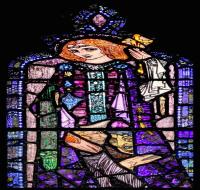
Feast day: 30 May
St Dympna was born in Ireland in the seventh century AD. Her father, Damon, was a petty king of Oriel. Her mother was a devout Christian. When Dympna was fourteen years old, she consecrated herself to Christ and took a vow of chastity. Shortly after this her mother died. Damon had loved his wife deeply and her death affected his mental health. Eventually his counsellors persuaded him to remarry but only if his bride was as beautiful as his dead wife. He could not find any woman as beautiful and he began to look at his daughter who very much resembled her mother.
When Dympna realised that her father was beginning to desire her she fled from his court, together with her confessor Father Gerebernus, two trusted servants and the king’s fool. They sailed together to the continent to what is now Belgium and took refuge in the town of Geel. One tradition states that, once settled in Geel, Dympna built a hospice for the poor and sick. However, some of the coins used in her charity allowed her father to trace their source. He sent agents to pursue Dympna and her companions. When they were discovered, Damon travelled to Geel to capture his daughter. He ordered the soldiers to kill the priest and tried to force Dympna to return to Ireland. She resisted and he cut off her head. She is said to have been about fifteen years old when she died. The residents of Geel buried Father Gerebernus and Dympna in a nearby cave. Years later, they decided to move the remains to a more suitable place.
In 1349, a church honouring Dympna was built in Geel. By 1480 so many pilgrims were coming from all over Europe, seeking treatment for mental disorders, that the church housing for them was expanded. Soon the sanctuary for those considered “mad” was overflowing, and the townspeople began taking them into their own homes. Thus began a tradition of ongoing care for the mentally ill that has endured for 500 years. Patients are still taken into the homes of Geel’s inhabitants. They are never called "patients", but rather "boarders", and are trusted as useful members of the town. They work often in menial labour and become part of the community, staying short- or long-term. This method of treatment has been much admired and studied.
The remains of Dympna were later put in a silver reliquary and placed in the church in Geel, which is named in her honour. The remains of Gerebernus were moved to Xanten in Germany. The church still stands on the site where her body is believed to have been first buried.
During the 2022 season, St Dympna’s Church in Belgium commemorated the saint by hosting an exhibition showing the restored altarpiece (by Goossen Van der Weyden) venerating Dympna. St Dympna is the patron saint of mental illness.
St Dympna, pray for us.