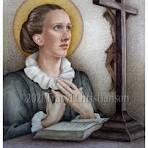
Feast day: 15 September
Catherine of Genoa was born in that city in 1447, the last of five children. Her parents were Jacopo Fieschi and Francesca di Negro. The family was connected to two previous popes and Jacopo became Viceroy of Naples. Catherine wanted to enter a convent when she was thirteen, possibly because her sister had become an Augustinian nun; however, the nuns to whom her confessor applied on her behalf refused to consider her because of her youth. Catherine seems to have given up the idea after that.
Her father died in 1463 and Catherine was married at the age of sixteen to a Genoese nobleman, Guiliano Adorno. He had been engaged both in the military and in trade and came back to Genoa with the idea of getting married. It is probable that the marriage was arranged to end a feud between the two families. It was a disaster. Guiliano was a violent, ill-tempered and unfaithful husband. He was a spendthrift and he made life miserable for his wife, who remained childless. After ten years of suffering she prayed to God that she might be kept ill in bed but her prayer was not answered.
After ten years of marriage, during confession, she had a mystical experience in which she felt an overwhelming feeling of God’s love for her. She abruptly left the church without completing her confession. She began a life of prayer without using forms of prayer like the rosary. She began to receive communion almost every day, an exceptional practice at that time for lay people. She went through many more mystical experiences.
This led her to care for the sick in a hospital in Genoa where she was joined by her husband who himself had undergone a conversion. He later became a Franciscan tertiary. His spending had ruined them financially. They decided to live in the Pammatone, a large hospital in Genoa, and to dedicate themselves to works of charity there. Catherine eventually became manager and treasurer of the hospital.
She died in 1510, worn out by by labour and by her spiritual exertions. Her death was slow and painful. In 1541, 31 years after her death, a book about her life and teaching was published entitled Book of the Marvellous Life and Holy Teaching of the Blessed Catherine of Genoa. This is the source of her Dialogues on the Soul and Body and her treatise on Purgatory. Her thoughts on Purgatory are original for the period, concentrating on the love of God as purgative rather than purification by fire. Her writings influenced people such as St Robert Bellarmine, Francis de Sales and Cardinal Henry Edward Manning.
Catherine of Genoa was canonised in 1737 by Pope Clement XII.
St Catherine of Genoa, pray for us.