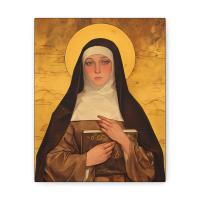
Feast day: 9 March
Catherine came from an upper class family. Born in 1413, she was the daughter of Benevenuta Mammolini of Bologna and Giovanni Vigri, a Ferrrarese notary, who worked for Niccolo III d’Este, Marquis of Ferrara. She was raised at Niccolo’s court as lady-in-waiting to his wife Parisina Malatesta and she became a lifelong friend of Niccolo’s natural daughter Margherita d’Este. During this time she received a good education in reading, writing, music, playing the viola and had access to illuminated manuscripts in the d’Este Court library. Her viola can still be seen in a glass case (this would be an earlier version of that instrument, as the modern viola was not made before the sixteenth century).
In 1426 Niccolo executed his wife, Parisina d’Este, for infidelity. Catherine left the court and joined a lay community of Beguines, living a semi-religious life and following the Augustinian rule. Beguines were groups of women who did not take vows, although they promised not to marry while they were Beguines. They were free to leave at any time. They aimed to imitate Christ in looking after the poor and sick and engaging in spiritual devotion. Some of the women wanted to adhere to the Franciscan rule and eventually the house was converted into the Observant Poor Clare Convent of Corpus Domini. This grew from twelve women in 1431 to 144 women at the end of the century. Catherine lived at Corpus Domini, Ferrrara, for most of her life, serving as Mistress of Novices. She was renowned for her holiness and experienced miracles and visions of Christ, Mary, Thomas à Becket and Joseph as well as foreseeing future events such as the fall of Constantinople in 1453. She wrote a number of treatises, lauds and sermons, and copied and illustrated her own breviary.
In 1455 the Franciscans and governors of Bologna asked Catherine to become abbess of a new convent, to be named Corpus Domini, in Bologna. She left Ferrara in 1456 along with twelve sisters to start the new community, and remained in Bologna until her death on 9 March 1463. Catherine was buried in the convent graveyard, but after eighteen days a sweet smell emanated from the grave and her body, which was incorrupt, was exhumed. It was eventually relocated to a chapel in the church, where it remains on display. Catherine is dressed in her religious habit, seated upright behind glass. A cult developed and Catherine was finally canonised in 1712.
Catherine’s best-known text is Seven Spiritual Weapons Necessary for Spiritual Warfare, which she appears to have written first in 1438 and then rewritten and augmented between 1450 and 1456. When she was near her death, she gave the work to her confessor and told him to send a copy to the Poor Clares at Ferrrara. The treatise was circulated through a network of Poor Clare convents. It was first printed in 1475 and was later translated into several languages. It was a valuable example of late medieval vernacular mysticism. Part of the book describes her visions both of God and Satan. In addition to this, she wrote lauds, short religious treatises and letters, as well as a 5000-line Latin poem called the Rosarium Metricum, the I Dodici Giardini and I Sermoni. These were discovered around 2000. The Twelve Gardens is a mystical work of her youth, the Rosarium is a Latin poem on the life of Jesus and the Sermons are copies of Catherine’s words to her sisters.
Catherine is significant as a female artist, whose artworks are preserved in her personal breviary. Though her artistry took valuable time, she regarded it as a way of increasing devotion in herself and others. She meditated while she copied the scriptural text, adding about 100 prayer rubrics, and drew initials with bust portraits of saints, paying particular attention to images of Clare and Francis. Besides multiple images of Christ and the Christ Child, she depicted other saints, including Thomas à Becket, Jerome, Paul, Anthony of Padua, Mary Magdalene and Catherine of Alexandria. There are also other panel paintings of Christ and the Madonna attributed to her. She seems to have had a particular devotion to St Ursula, as there are two images of this saint which are also attributed to Catherine. Her self-taught style incorporated motifs from needlework and devotional prints.
St Catherine of Bologna, pray for us.