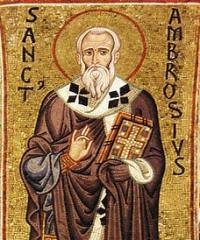
Feast day: 7 December
Ambrose was born into a Roman Christian family, of Greek descent, in 339. He began life in Augusta Treverorum (now Trier), the capital of the Roman province of Gallia Belgica, in what was then northern Gaul and is now in the Rhineland Palatinate. It is uncertain who his father was but what does seem certain is that he was either the praetorian prefect or part of his administration. According to legend a swarm of bees settled on the infant Ambrose’s face as he lay sleeping and his father considered this to be a sign of his future eloquence and honeyed tongue. Bees and beehives often appear in his iconography.
Ambrose’s mother was intelligent and pious. He was the youngest of three children. All three children became venerated as saints. Early on in his life Ambrose’s father died and his mother moved from Trier to Rome. There Ambrose studied literature, law and rhetoric. He then followed in his father’s footsteps and entered public service, He was first made a judicial councillor and in 372 he was made governor of the province of Liguria and Emilia, with headquarters in Milan.
In 374, the bishop of Milan, an Arian, died and the Arians challenged the succession. Ambrose went to the church where the election was due to take place, to prevent an uproar. His address was interrupted by a call, “Ambrose, bishop!”. This was echoed by the whole assembly. Although he accepted the Nicene Creed, the Arians accepted him because he had been tolerant about their beliefs. He was reluctant to take office, which he was not prepared for, and - though a Christian - he had not yet been baptised. He hid with a friend, who on receiving a letter from the Emperor Gratian approving the appointment, gave him up. He was baptised, ordained and consecrated as the new bishop of Milan. This was the first time in the west that a member of the upper class of high officials had accepted the office of bishop.
He adopted an ascetic lifestyle, giving money to the poor and donating all his land, except for providing for his sister. He respected local customs. He believed it was important to set an example to those he governed. He was very popular, which meant that he had considerable political influence. His brother Satyrus resigned a prefecture in order to move to Milan, where he took over the management of the diocese’s temporal affairs.
Arianism caused problems for Ambrose for over half his term in the episcopate. Arius, who died in 336, was a Christian priest; around the year 300 he asserted that God the Father must have created the Son as a lesser being, not eternal, and different in essence from the Father. This heresy spread throughout Egypt, Libya and other Roman provinces. The Western Emperor Gratian supported orthodoxy but his younger half brother Valentian II, who became his colleague in the Empire, adhered to the Arian creed. Arianism appealed to high level leaders both secular and clerical. The Emperor Gratian was persuaded to call a General Council from all parts of the Empire; Ambrose however, fearing the consequences, prevailed upon the Emperor to have the matter determined by a council of the Western bishops. A council was held in Aquileia in 381. Ambrose was elected president. A vote was taken and the two prominent Arian leaders were deposed from their offices.
Ambrose had good relations and varying levels of influence both with Gratian, Valentian II and the Eastern Emperor Theodosius I. Scholars debate over Ambrose’s connection with Valentian, as to whether it was a personal friendship or not; it seems, however, that he had a good working relationship with the Emperor. Gratian was personally devout and - as stated before - an adherent of the Nicene creed. Ambrose did write a large number of books, letters of theology and spiritual commentary which he dedicated to Gratian.
The Battle of Adrianople in 378 changed the political scene. The Roman Empire was heavily defeated in a battle with the Goths. Gratian withdrew to Sirmium (now in modern Serbia). There, Arian rivals of Ambrose warned Gratian that his faith was suspect. Gratian wrote to him asking him to explain his faith. The two met in Milan for the first time in 379 and Ambrose impressed the Emperor, as they both had similar backgrounds. The latter returned to the city in 380 to find that Ambrose had written a two volume work named De Fide, which was a statement of the bishop’s orthodoxy and political theology. It was also a polemic against Arianism intended for public discussion.
Gratian was childless and treated his brother Valentian II as a son. Ambrose, however, made an enemy of Justina, his mother, by appointing a Nicene bishop at Sirmium. Gratian was assassinated in at Lyon and Justina was left in the position of regent. She and a considerable number of clergy, laity and military professed Arianism.
The Arians demanded that the new Emperor allocate two churches to them in Milan, the Basilica of the Apostles in the city and St Victor’s in the suburbs. Ambrose retorted with the following words: “What belongs to God, is outside the Emperor’s power.” An attempt was made to take the Basilica by the Arians but imperial soldiers poured into the church assuring Ambrose of their fidelity. He sent a sharp message to Valentian, refusing to give up the Basilica and declaring that he would die rather than do this. Valentian gave in saying: “Soon, if Ambrose gives the orders, you will be sending me to him in chains. ”
Another attempt was made by the Arians led by Justina and Valentian to seize a church but this failed. There was an attempted kidnapping, an attempt to arrest him and force him out of the city and several more accusations were made against him. However no formal charges were made, probably due to his popularity.
When the general Magnus Maximus usurped power in Gaul (383) and was considering an invasion of Italy, Valentian II sent Ambrose to dissuade him. At first he was successful but later Magnus Maximus invaded Italy (386-7) and Milan was taken. Justina and Valentian fled but Ambrose remained and had the church plate melted for relief of the poor. Meanwhile, the Eastern Emperor Theodosius made a counter-attack, defeating the usurper at Aquileia in 388, and brought the restored Emperor to Milan. Theodosius stayed on in Italy to restore order and appointed his Frankish general as magister militum. Tensions soon arose between himself and the young Emperor, who was later found hanged in his bedchamber. It is unclear whether this was murder or suicide. Ambrose’ eulogy at his funeral is the only contemporary source for the Emperor’s death.
While Ambrose was writing his De Fide, Theodosius published his own statement of faith in 381 in an edict, establishing Nicene Christianity as the only legitimate version of the Christian faith. The aftermath of the death of the preceding Emperor had left many questions unresolved and Theodosius was anxious to address these questions, as he established himself as ruler and affirmed his personal piety. In 380 Theodosius issued the Edict of Thessalonica, a decree addressed to the citizens of Constantinople, declaring that only Christians who did not support Arianism could have their places of worship recognised as churches. It did not however give preference to Christianity over other religions.
The massacre of Thessalonica in 390 occurred after a Roman official was killed during a riot. Theodosius ordered the slaughter of thousands of civilians. Ambrose excommunicated him and demanded that he do public penance in a letter which still exists. Theodosius complied, coming to church without his imperial robes. Ambrose then gave him communion. There is again a dispute between scholars of the influence that Ambrose had over Theodosius. It is generally agreed now that the relationship was more about negotiation between two powerful figures than anything that resembled friendship. They did not meet very often. At his funeral in 395, Ambrose gave the eulogy. He himself died two years later in 397. His body may still be viewed in the church of St Ambrogio in Milan.
Ambrose was a passionate little man with a high forehead, long melancholy face and great eyes. He was often involved in political affairs but he still cared for the wellbeing of his flock. He preached and celebrated the Eucharist many times in the week and was generous to the poor. He had good relationships with all kinds of people. On the other hand, he was not afraid of conflict when it involved ecclesiastical matters. He was clear on the limits of imperial power. He has been accused of antisemitism in some of his actions but he was also a great admirer of the Jewish writer Philo of Alexandria, treating him as one of the “faithful interpreters of the Scriptures”. He also used Josephus, Maccabees and other Jewish writers as sources for his own writing. He opposed pagan practices which were still occurring in the Empire.
Ambrose furthered the growth of church doctrine and priestly ministry including teaching, administering the sacraments and giving pastoral advice. He was flexible as regards liturgy, seeing it as a tool to serve the people in their worship of God. He respected local practice. In his most important work, De Officiis, he writes of justice and generosity. He was very much influenced by Cicero and the Book of Genesis for a concept of mutual inter dependence in society. He studied theology with Simplician, a presbyter of Rome. As he was fluent in Greek he used this knowledge to study Philo, Origen, Athanasius and Basil of Caesarea. He became a famous orator, whose words influenced Augustine. The latter reports in his Confessions that Ambrose was too busy to answer his questions and he wished that he could share his burden with the bishop. However, Ambrose set Augustine on his path to embracing Christianity.
Ambrose has been called the father of Mariology. The virginity of Mary was central to Ambrose’s teaching. He also wrote on eschatology, on Christ’s divinity, on sin and divine justice, and on personal faith. He was a prolific writer. He is also renowned for writing hymns although only four can definitely be attributed to him.
Ambrose was declared a Doctor of the Church in 1298 by Pope Bonifice VIII.
St Ambrose, pray for us.